
Entertaining Hell

Go back to your wisdom - Virgil to Dante, Purgatorio canto 6
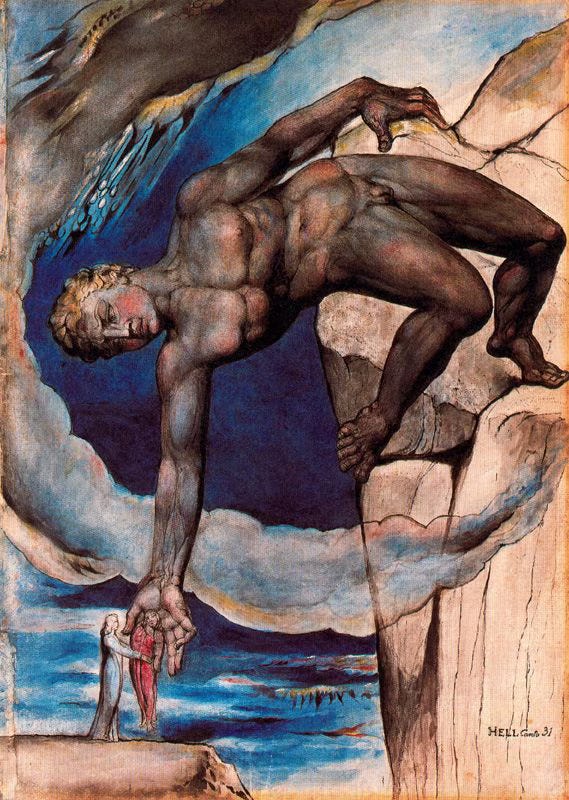
Good morning.
I’m considering hell. I should capitalize to give the full thrust of harsh church: I do mean Hell.
I’m a worldly, rational, post-modern person. I’m political. I spent most of my time as a spiritual teacher trying to get folks back to reality. I believe both in science and the intensity of this world. And here I am, contemplating eternal damnation.
Of course, I’m a philosopher and a yogi; I’ve spent a lot of time testing the powers of the mind. A mind will give us heaven and create a veritable hell. Hell is not a place of torture inflicted by God, but a soul’s choice to reject God. It’s a state of being characterized by apathy, isolation, the wa wa wa of living despair. I’ve been there and so have you. But I’m going beyond that. I don’t mean seems or feels like: I mean real Hell.
The morning is right for it. I have a couple of days off of work, so I should be happy. But I am not happy. After a fool’s spring, the cold outside is painful. G is in Baltimore for several days: the dog and I are alone. She paces and whines. The kitchen is a disaster after several days cooking on the run and never cleaning up. I’m hungry. I’m lonely. I’m tired. I don’t want to clean the kitchen because the floor is cold. I don’t want to go buy any groceries because it’s colder out there than it is in here. The dog is pissing me off. To get her to stop, I will eventually put on the coat and the scarf and the boots and the gloves: but I am sick to death of them. They feel dirty and I believe they smell. My skin goes red where sleeves bunch and hemlines rasp. I have a new computer, which ought to make me grateful, but instead I find it annoying because I have to set it up, which requires resetting a password I forgot years ago. The new cursor is inordinately large and this bothers me to distraction. All together, I expect to squeak through a tormenting mass of errands just in time to go to back to work. Thus I am damned, even if it’s only in the minorest pale circles of the outskirts of Hell. The kind where people whine and sigh a lot while itching an elbow.
I’ve been trying to reckon with the evil of the world. I rejected religion a long time ago because of the mere idea of evil: it seemed a cop out. But at this point in my life - at this point in history - I find I can’t ignore it.
I was considering how quickly humans forget, and how easy it is to self-center, how truly ineffective things like ‘empathy’ are to anything but our own little heavens and personal hells. So long as we can still get Amazon deliveries, so long as we don’t have to see masked and armed federal agents or be inconvenienced by politics, we move on. We generally only ‘care’ when it hits close to home. But human suffering is larger than our personal interest and continues past our own suffering’s relent. While it is existentially true that I can improve my interior world, even true that I can contribute to my people’s wellbeing, this doesn’t and in vital ways cannot address the madness of the suffering world. Can it?
Does none of it matter, then? Do we just roll on? Is villainy human nature and unfathomable violence the undying truth of history? Do we have to make do with small blessings?
I’d rather find enormous comfort, glorious comfort, in the difficulties of the real.
I was talking to my cohort of yoga philosophy students and trying to describe the accepted vast difference between jñānam and prajñā - both of which translate to wisdom, understanding, or knowledge. They translate the same, but there is a qualitative difference: one is theory and the other is lived. The possibility of the second - a lived, experimental, time based wisdom - is both the way and the promise. If we can start to remember life’s lessons, then we don’t merely ‘go on’; the path is changed. Things start to matter.
Then I reread Wurthering Heights and found myself writing about the value of moralizing. Brandon Taylor’s Minor Black Figures has stuck in my craw for several months, mainly because he’s bold enough to throw a priest into contemporary fiction; I was left feeling I’d just read a great social novel along the lines of Henry James. His ‘atheist money theology’ is brilliant. The folks most attached to their ‘free will’ are generally the first to blame a system. It’s gold.
I’d also recently read George Saunders’ Vigil, which starts with a Buddhist kinda idea of maybe ghosts are real. He then goes into his lovely storytelling, making us love and hate characters who are actually dead. What if, he makes us wonder, the questions of our lives don’t end when our lives do? Maybe the problems - even the ruthlessly personal ones - get louder or worse after we die. Maybe entertaining Hell can be useful.
The most unenlightened thoughts I have have to do with a sense that there aren’t any consequences. Neither my thoughts or actions ‘matter’.
Life itself proves this ain’t so; everything is cause and effect. Beyond-my-consciousness-life gives the rather chilling, but also brassy, possibility of these consequences being infinite. I think most of us would say we’re already living that way, that we ‘care’. I believe that we do care. Our personal weather system of heavenly times and hellish times are absolutely real and terribly difficult to navigate.
The vast scale of ultimate reality or pure logic is terrible, of course. Maybe that’s why body brains are hardwired for selfishness: it’s simple self-preservation.
So this morning I found myself thinking about Dante. I spent an hour thinking I needed to find a good translation, and wondering about time and money, libraries and bookstores, before I realized I probably already had a copy upstairs. I don’t know it well. I’ve always had other favorites of the less Catholic and demony variety. But it’s absurd to think I wouldn’t have given the Commedia a glance at some point in my reading life, and if I ever had it I would have kept it around out of a basic respect. I value a respectable library.
And it’s true: I already have what I need. I wrap myself in a blanket and settle in.
The Dante I have is pale and brittle. The pages are yellowing to an almost brown on the edges, and so dry as to be rippled and frequently stuck together. I spend twenty minutes contemplating hell as a maturity process, a pinnacle of philosophy. I climb through lines of poetry at random. When I feel the cold draught from the window or look at the frosted glass, I move my mind to an infinite coldness, a careening forever cold. Somehow, this both makes me warmer and turns the ice into something pretty again.
Then I feel ready. I put on the coat the hat the boots the scarf the gloves. The dog and I sally forth. I intentionally walk us toward the local Catholic Church. It’s Vietnamese. The bells drift through my days. I’ve never been inside. We walk around it, she peeing and I looking up at the windows, stomping my feet and bouncing to keep warm. I hurry her back and go out for food. Butter, first; if I bake the house will be a little warmer.
I start to chide myself and find chiding myself unexpectedly helpful: oh poor me in the cold, when in fact I don’t much have to deal with it. I am not a laborer in medieval times nor am I unhoused in the modern world. Oh I’m so busy at my soulless retail job, I think, but can quick counter that with nor do I live by the sweat of my brow, or in pre-worker’s rights industrial conditions. I’m too tired to do anything fun, I whine, while knowing full well I have a record player at home and museums I could go to and friends I could call. Knowing that if I sing, or play, or laugh, my perspective wholly changes. Every thought matters.
I start this essay with the quote. Go back to your wisdom. I choose to say wisdom where Dante said scienza..
Scienza is translated in one place I look as ‘philosophy’ and in another place as ‘logic’; a trail of footnotes suggests Virgil in the mouth of Dante is referencing Aristotle.
Therefore: wisdom, philosophy, and science aren’t different things, nor at their heights are they opposed. The elevations of science and intellect and philosophy conjoin, and as I’m poking about in Dante who is referencing Aristotle, they all end in Heaven.
Or Hell. There is the hanging question of the thing.
“Moving again, I tried the lonely slope — my firm foot always was the one below.” (Canto 1.30)
This is a recurring observation in my life: people I know to be smarter than I am - infinitely so, I’d say, no matter whether they are alive or centuries dead - are unanimously folks who believe. My firm stance is always a little low. Perhaps the validity of Hell is neither repentance nor consolation, but the possibility of something more sublime.
The Commedia, so far as I can recollect, is a story about becoming: an exiled traveler narrator goes through hell - while fully alive, mind you - and reaches faith. The journey is what qualifies him in the living world: in his own estimation, Dante believes it is the Comedy that made him a true poet. History agrees with him. Dante’s through-hell is a journey from error to truth, from despair to hope, from loneliness to love, from doubt to faith, and from inexperience to sublime experience. There is no shortcut.
The Commedia is a spiritual journey, but it is also a political question: what is infinite wisdom? What is the validity of soul given the crimes of the world? The Commedia is a story about witnessing and struggling to comprehend extremes of violence and horror. It is rebelling against a violent city-state and exploring the landscape of exile. Most war poetry and grief poetry is in conversation with Dante, explicitly or no, whether the poet knows it or not.
The Commedia is also - although in my ignorance I’m reaching here and don’t really know how Dante deals with it - a love story. I do mean romantic love - there is this Beatrice character - but I also mean friendship: Dante doesn’t go through Hell alone. Virgil, Rome’s greatest poet and a ghost of long centuries - “pale from long silence’”- is there to guide him. Which makes another layer of meaning: what use is history to a soul, politics, or love?
The deep disparity in their relationship raises questions: one is already famous, the other is worse than unknown, he’s an outcaste; one is already wise, the other is lost in his own mind. Virgil is the poet of Rome’s founding, Dante will be the poet of its corruption. Virgil, "a virtuous pagan”, can’t go the full journey; Dante will lose him in the end.
As we will lose everyone. The Commedia is a guidebook not only for finding love but a poetics of saying goodbye.
Whether Hell is a place or has anything to do with time is beside the point - a wrong because selfish use of the possibility. Hell provides a way - a door, a path - to encounter things beyond our ability to understand but entirely within our power to influence.
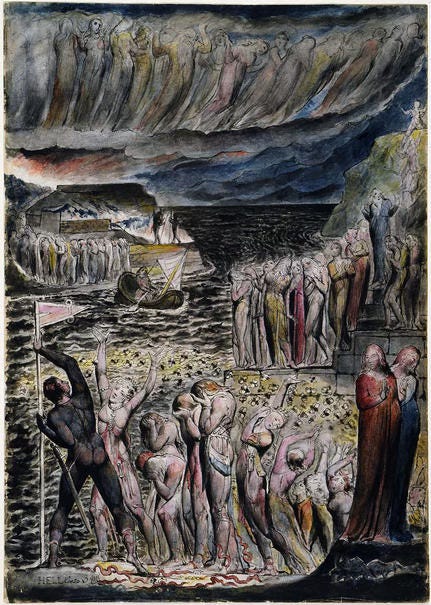
“Find your saints,” I often told students. Look for and engage with the luminaries and advocates of whatever it is you love.
Faith is deeply rational. It will be the logical conclusion of philosophy and the end of a good life, though its face is never what you’d expect.
It’s here that we really rub up on the question of free will. Basically, a willingness to moralize or a choice to turn back.
The oven is ready, the butter a giving room temp, so I’ll leave you here. Maybe I’ll read more deeply and share more later.
Maybe this is enough:
And just as he who unwills what he wills
and shifts what he intends to seek new ends
so that he's drawn from what he had begun,
so was I in the midst of that dark land,
because, with all my thinking I annulled
the task I had so quickly undertaken.
Canto 2.