True Crime
and actual hell

A recurring thing I do at the bookshop is re-organize a section. There is something corporate about this: directions come down from Home Office that are intended to keep individual stores recognizably homogenous. This is perhaps more in the way of not letting things get out of control than it is about conformity. It’s also a little like gardening, a routine engagement to pull the weeds while supporting both what is currently blossoming and what will come to be if everything goes well. It’s about placing little seeds and licking your thumb to taste the winds. It has to do with what has sold, what has come in, what’s happening in movie theaters or news headlines, and the general principle of entropy and chaos if you let things get haphazard. It feels like curation: a display of taste and a tasteful display. I am creating a catalyst for discovery, which has homage and a possible journey presented in a nice little experience for people who may never really know what went on behind the scenes.
I’m good at this. I’m good at discerning the spirit from the law and picking up on what’s vital. I’m also just a really hard worker. Partially because I’m good at this, but for other reasons too, I’ve been promoted. My retail job now feels a little less like a maybe I’ll be chucked tomorrow and more like fact of life. I have bought additional pairs of sneakers and a lunch bag. Keys jangle from my lanyard.
Yesterday I tackled the True Crime section.
I’m good at stuff but I’m also a snob. Given my druthers, I’d loiter with the art monographs and try to convince folks they should read literary giants rather than commercial goop. I’d drag folks to the history section muttering hotly about facts, and I’d fill their arms with philosophy asking them about ultimate meaning. I’d reverently hand them thin little volumes of poetry. True crime brought a little snarl to my lip. I thought about the dregs of culture and reality T.V. There are tabloids blowing in the wind of a subway tunnel, Judge Judy reruns wafting through suburban American afternoons, and ghost stories at the edges of rural backwoods. I wondered what that does to a person. Or a country.
Handling several hundred books about kidnapped children, murdered women, killing sprees and the unrelenting onslaught and cover up of murdering native folks left me queasy. It rubbed all my daydreaming about the nature of humanity: are we good or bad? I was quietly chanting lines of Dante while I dusted the shelves. A co-worker ambled by and stopped to take in my work. “I know it isn’t just America,” I said, “but what in the world is wrong with us? as a people?” I held a James Patterson thing about Epstein in my hand and sighed. There’s a reason I haven’t written about Epstein.
I haven’t written about Epstein because I haven’t paid much attention to it. I’ve avoided. It isn’t shock, nor even really disgust. I am not surprised. I was once a young girl. I am angry, which found expression one afternoon in being outraged that Nabokov’s Lolita could be so offensively misused. Of course this isn’t about literature, this is about people; but our feelings are gonna express where they can and down the grooves that they know. How dare they, I muttered.
But mostly I’ve avoided Epstein because there were too many other things to pay attention to. While real, the Epstein crap seemed a deflection, a circus diverting our attention from matters at hand. It seemed the wrong use of the provocative. While I avoided taking in the details and swiped my phone past all mentions of the thing, I was also trying to find right uses of anger and grief and respect, which personally has to do with advocacy and love rather than voyeurism.
My behavior could also be considered willed ignorance.
While rinsing and patting dry a chicken breast for dinner, I asked G what he thought about American violence. He’s a data guy. He pays attention to darker and deeper politics than I do. He said it isn’t that Americans have more cults or organized crime or serial killers than the rest of the world, but that Americans have caught more of them (and yes, made Hollywood and pop culture out of it). He also said that only 50% of murders are ever prosecuted. A person has a 50/50 chance of getting away with it.
I know that the oceanic majority of violence is small and local. It’s close to home.
I lit the gas under the grill pan and waited, looking out the window at the birds until the oil spat.
True crime books used to be put in the culture and politics section. But the thing is, the people who read sociology and anthropology are not the same people who would read true crime. The books would languish and become dead stock. If they are moved nearer Mystery and Thriller, just off of Horror, fiction with a racing heart, it sells.
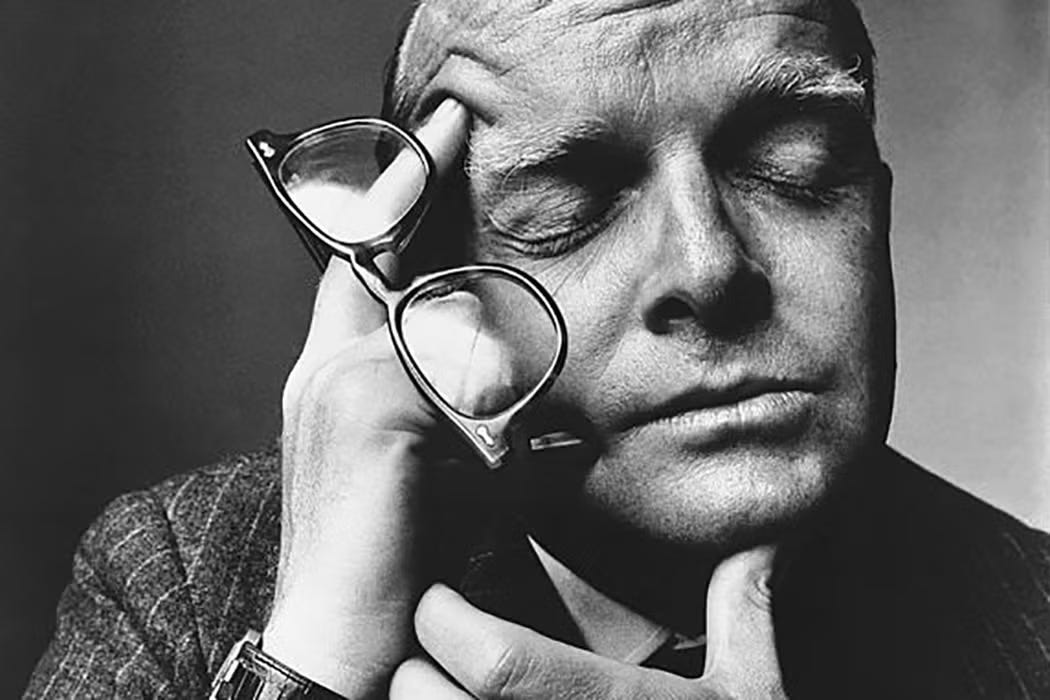
It wasn’t all trash. Not even a little bit. Here was Capote: genius, lonely, troubled gay man who agonized over writing anything meaningful at all, eventually finding his way in the writing of In Cold Blood. Capote wanted to challenge his own skill if not literature itself. He wanted to move beyond the vapid navel gazing of fiction. At first he saw the task as easy: a wide open field in Kansas he could stick a flag in. But as he spent intense years researching and interviewing the suspects, Capote surprised himself with a personal and emotional connection. He felt a deep kinship with one of the murderers, Perry Smith. They both had had severely troubled, unstable childhoods scarred by parental abandonment and social isolation. Capote came to think of Perry Smith as a dark, tragic mirror of his own life. A there but by the grace of experience that probably has something to do with all salacious art.
Here too was Susan Orlean’s The Orchid Thief, one of the first books I really read and adored in journalism . I read it over and over again, studying what she was doing. The capacity to do such a thing is so close to what I most feel in my own urge to write. Orlean is hilarious, and quirky, and the story is more bizarre than any possible fiction. I thought of Dostoevsky’s Crime and Punishment, Roskonikov desperate and destitute in 1860’s St. Petersburg, driving himself insane with meaningless suffering and anarchy and a realization that he could get away with murder.
Why, after all, do I joke but not really that I want to write a murder mystery?
I want to write a murder mystery because it’d sell. I’m not trying to be arrogant; I’m trying to be honest about the fact that any mull of my own has very little interest. Selling out is the best way to write anything at all: it can have gorgeous language, and irritant questions, and moving cries so long as it’s packaged right. Of course there’s the danger of selling out wholesale and losing the plot, but if I’m gonna make a real thing it’s got to have some salt and chew.
This is true of everything. Ideals will freeze you dead and get you exactly nowhere, and selling out will macerate your goodness, but everybody’s got to make a living.
It’s a question of how we deal with reality. I had one mentor say I should, as a teacher, give people 90% of what they want and 10% of what is actually the real point. When I mentioned this to another mentor, he scoffed and flipped the numbers. Everybody’s got to make a living, is what I’m saying: we’ve got to consider how much of ourselves we’ll sell in order to have a life, as well as how much we blur a real life with what is merely entertainment. It’s a numbers, or maybe a wave, kinda thing.
We recently watched a play that was an adaptation of Sophocles’ Antigone. A spectacle and warning of the passion for vengeance. If, goes something theoretical, we can turn human darkness to ritual and symbol, there might be less of it in the world. So many things are ritualized war, or allegorical rape, or a state spectacle of violence. An abstraction of hate and selfishness. Like the gladiatorial games in Rome. This theory has the iffiness about it. Yes, a book or a film can make the blood thrash and the tongue water. Folks will perhaps glean an understanding of their own greed, or resentment, or cruelty. They might then be more prone to recognizing small harm, or have a subliminal sense of gratitude for the normalcy of their life when the show is over and the book is ended.
On the other hand, crowds swell to a madness.
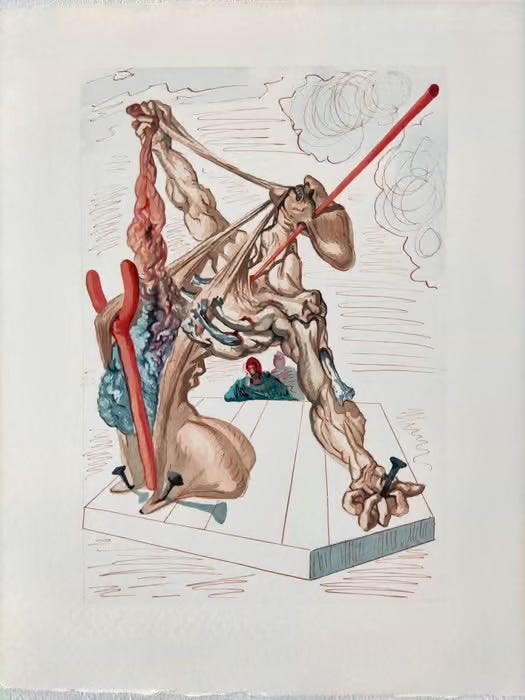
In Inferno, Canto XXIX, Dante runs into Alypius, a roman legal scholar. Alypius thought he was smarter than everybody else, and could avoid the blood lust of the games. Later he converted to Christianity with St. Augustine. But what is at the heart here is the corruptibility of a high mind, the unlookawayableness of spectacle. Dante brings him up as a way to personify the slipperiness of morality. “I can go along with my friends;” said Alypius; “when the vital moment comes, I’ll just close my eyes.” he says. “I won’t look.”
So Alypius goes to the colosseum. He stands in the bleachers, surrounded by cheering and pressing bodies. In a toast, with a smile, he clinks his wine glass against the glass of a friend. As the frenzy mounts, as the people rise to their feet and the air gets thin, he smiles and he closes his eyes.
But when the roar around him peaks and he feels the adrenaline surge with a deafening hot cold pinch, a bunching of muscle, his eyes instinctively flick open. He can’t help it. Alypius looks.
Sport can channel belonging and physical pentness; we bond with those who share our shame and the vendetta is turned into a ceremony. Religion can abstract a need for personal vengeance. The state can and should monopolize violence and punishment, with a clear understanding that governments are messing this up. And art, whether high or low, can scare us with the truth and make us grateful for the plainness of our own lives. There is some essential not-me-aloneness that happens, but also a savoriness that validates our selfness, I-ness, our living and real alienation.
In dealing with the honest smoking blood of reality, I want the notes to be savory but not salacious. Redemption can’t come without earnest reckoning, and this is less a genre problem than a personal one. Criminal justice writing of the sociological or anthropological bent often humanizes criminals - and rightly complicates the question of personal guilt with social forces - but leaves the question of accountability hanging. True crime sensationalizes violence but does little to really humanize either criminals or victims, let alone society at large which is both criminal and victimized at one and the same time. It’s easy to criticize Rome, to blame Alypius for going to the games in the first place, but this is a chosen simplicity that verges on the delusional. Real life is beastly. We’re awful people who can at times realize something wonderful.
Inferno canto XXIX is the final round of the eighth circle of hell, populated by the Falsifiers. The landscape is horrific: there is screaming and the sinners reek with scabs, leprosy, and plague. Dante is mesmerized by the grotesque mayhem all around him. He lingers both to weep and to watch. Virgilio sharply rebukes him, citing the story I’ve told you of Alypius and the colosseum. “Time is short!” Virgilio scolds. Don’t be fascinated by the suffering all around; press on.
I want a little less voyeurism. I want something more like true anger. And grief. And respect.
I’m off to work. Today I’ll be dusting off the cookbooks.